
Press briefing: Case closed on shooting of American citizen Tristan Anderson
Posted using ShareThis
February 1, 2010


Nasser Gawi expelled from Sheikh Jarrah
Nasser Gawi expelled from Sheikh Jarrah – settler detained, weapon seized
Again this is the family I stayed with in SJ.
Posted using ShareThis
Again this is the family I stayed with in SJ.
Posted using ShareThis
January 30, 2010
“We must transfer our anger to the brutalities of our time.” Howard Zinn dies at age 87
Personal Thoughts: This is one of the greatest speech's I have heard. The points Zinn makes are revolutionary but yet so simple. THINK!!
 From the Blog: The Politics of Hope by Mark Braverman
I graduated from Columbia in 1970. Students had closed down the campus that Spring over the U.S. bombing of Cambodia. Two years earlier the campus was in turmoil when students and faculty occupied several buildings in protest over the University’s plans to take over a chunk of the local neighborhood in upper Manhattan to build a gym. The President of Columbia had sent in NY riot police to break heads and drag out the protesters. So when that President took the podium at our graduation, several hundred of us ceremoniously walked out and held a counter-commencement. The speaker was Howard Zinn.
This week’s blog posting is a speech Zinn gave on October 10, 1999. You won’t be able to stop reading until you reach the end.
Some years ago, when I was teaching at Boston University, I was asked by a Jewish group to give a talk on the Holocaust. I spoke that evening, but not about the Holocaust of World War II, not about the genocide of six million Jews. It was the mid-Eighties, and the United States government was supporting death squad governments in Central America, so I spoke of the deaths of hundreds of thousands of peasants in Guatemala and El Salvador, victims of American policy. My point was that the memory of the Jewish Holocaust should not be encircled by barbed wire, morally ghettoized, kept isolated from other genocides in history. It seemed to me that to remember what happened to Jews served no important purpose unless it aroused indignation, anger, action against all atrocities, anywhere in the world.
A few days later, in the campus newspaper, there was a letter from a faculty member who had heard me speak—a Jewish refugee who had left Europe for Argentina, and then the United States. He objected strenuously to my extending the moral issue from Jews in Europe in the 1940s to people in other parts of the world, in our time. The Holocaust was a sacred memory. It was a unique event, not to be compared to other events. He was outraged that, invited to speak on the Jewish Holocaust, I had chosen to speak about other matters.
I was reminded of this experience when I recently read a book by Peter Novick, THE HOLOCAUST IN AMERICAN LIFE. Novick’s starting point is the question: why, fifty years after the event, does the Holocaust play a more prominent role in this country—the Holocaust Museum in Washington, hundreds of Holocaust programs in schools—than it did in the first decades after the second World War? Surely at the core of the memory is a horror that should not be forgotten. But around that core, whose integrity needs no enhancement, there has grown up an industry of memorialists who have labored to keep that memory alive for purposes of their own.
Some Jews have used the Holocaust as a way of preserving a unique identity, which they see threatened by intermarriage and assimilation. Zionists have used the Holocaust, since the 1967 war, to justify further Israeli expansion into Palestinian land, and to build support for a beleaguered Israel (more beleaguered, as David Ben-Gurion had predicted, once it occupied the West Bank and Gaza). And non-Jewish politicians have used the Holocaust to build political support among the numerically small but influential Jewish voters—note the solemn pronouncements of Presidents wearing yarmulkas to underline their anguished sympathy.
I would never have become a historian if I thought that it would become my professional duty to go into the past and never emerge, to study long-gone events and remember them only for their uniqueness, not connecting them to events going on in my time. If the Holocaust was to have any meaning, I thought, we must transfer our anger to the brutalities of our time. We must atone for our allowing the Jewish Holocaust to happen by refusing to allow similar atrocities to take place now—yes, to use the Day of Atonement not to pray for the dead but to act for the living, to rescue those about to die.
When Jews turn inward to concentrate on their own history, and look away from the ordeal of others, they are, with terrible irony, doing exactly what the rest of the world did in allowing the genocide to happen. There were shameful moments, travesties of Jewish humanism, as when Jewish organizations lobbied against a Congressional recognition of the Armenian Holocaust of 1915 on the ground that it diluted the memory of the Jewish Holocaust. Or when the designers of the Holocaust Museum dropped the idea of mentioning the Armenian genocide after lobbying by the Israeli government. (Turkey was the only Moslem government with which Israel had diplomatic relations.)
Another such moment came when Elie Wiesel, chair of President Carter’s Commission on the Holocaust, refused to include in a description of the Holocaust Hitler’s killing of millions of non-Jews. That would be, he said, to falsify the reality in the name of misguided universalism. Novick quotes Wiesel as saying They are stealing the Holocaust from us. As a result the Holocaust Museum gave only passing attention to the five million or more non-Jews who died in the Nazi camps. To build a wall around the uniqueness of the Jewish Holocaust is to abandon the idea that humankind is all one, that we are all, of whatever color, nationality, religion, deserving of equal rights to life, liberty, and the pursuit of happiness. What happened to the Jews under Hitler is unique in its details but it shares universal characteristics with many other events in human history: the Atlantic slave trade, the genocide against native Americans, the injuries and deaths to millions of working people, victims of the capitalist ethos that put profit before human life.
In recent years, while paying more and more homage to the Holocaust as a central symbol of man’s cruelty to man, we have, by silence and inaction, collaborated in an endless chain of cruelties. Hiroshima and My Lai are the most dramatic symbols—and did we hear from Wiesel and other keepers of the Holocaust flame outrage against those atrocities? Countee Cullen once wrote, in his poem Scottsboro, Too, Is Worth Its Song (after the sentencing to death of the Scottsboro Boys): Surely, I said/ Now will the poets sing/ But they have raised no cry/I wonder why.
There have been the massacres of Rwanda, and the starvation in Somalia, with our government watching and doing nothing. There were the death squads in Latin America, and the decimation of the population of East Timor, with our government actively collaborating. Our church-going Christian presidents, so pious in their references to the genocide against the Jews, kept supplying the instruments of death to the perpetrators of other genocides.
True there are some horrors which seem beyond our powers. But there is an ongoing atrocity which is within our power to bring to an end. Novick points to it, and physician-anthropologist Paul Farmer describes it in detail in his remarkable new book INFECTIONS AND INEQUALITIES. That is: the deaths of ten million children all over the world who die every year of malnutrition and preventable diseases. The World Health Organization estimates three million people died last year of tuberculosis, which is preventable and curable, as Farmer has proved in his medical work in Haiti. With a small portion of our military budget we could wipe out tuberculosis.
The point of all this is not to diminish the experience of the Jewish Holocaust, but to enlarge it. For Jews it means to reclaim the tradition of Jewish universal humanism against an Israel-centered nationalism. Or, as Novick puts it, to go back to that larger social consciousness that was the hallmark of the American Jewry of my youth. That larger consciousness was displayed in recent years by those Israelis who protested the beating of Palestinians in the Intifada, who demonstrated against the invasion of Lebanon.
For others—whether Armenians or Native Americans or Africans or Bosnians or whatever—it means to use their own bloody histories, not to set themselves against others, but to create a larger solidarity against the holders of wealth and power, the perpetrators and ongoing horrors of our time.
The Holocaust might serve a powerful purpose if it led us to think of the world today as wartime Germany—where millions die while the rest of the population obediently goes about its business. It is a frightening thought that the Nazis, in defeat, were victorious: today Germany, tomorrow the world. That is, until we withdraw our obedience.

I graduated from Columbia in 1970. Students had closed down the campus that Spring over the U.S. bombing of Cambodia. Two years earlier the campus was in turmoil when students and faculty occupied several buildings in protest over the University’s plans to take over a chunk of the local neighborhood in upper Manhattan to build a gym. The President of Columbia had sent in NY riot police to break heads and drag out the protesters. So when that President took the podium at our graduation, several hundred of us ceremoniously walked out and held a counter-commencement. The speaker was Howard Zinn.
This week’s blog posting is a speech Zinn gave on October 10, 1999. You won’t be able to stop reading until you reach the end.
Some years ago, when I was teaching at Boston University, I was asked by a Jewish group to give a talk on the Holocaust. I spoke that evening, but not about the Holocaust of World War II, not about the genocide of six million Jews. It was the mid-Eighties, and the United States government was supporting death squad governments in Central America, so I spoke of the deaths of hundreds of thousands of peasants in Guatemala and El Salvador, victims of American policy. My point was that the memory of the Jewish Holocaust should not be encircled by barbed wire, morally ghettoized, kept isolated from other genocides in history. It seemed to me that to remember what happened to Jews served no important purpose unless it aroused indignation, anger, action against all atrocities, anywhere in the world.
A few days later, in the campus newspaper, there was a letter from a faculty member who had heard me speak—a Jewish refugee who had left Europe for Argentina, and then the United States. He objected strenuously to my extending the moral issue from Jews in Europe in the 1940s to people in other parts of the world, in our time. The Holocaust was a sacred memory. It was a unique event, not to be compared to other events. He was outraged that, invited to speak on the Jewish Holocaust, I had chosen to speak about other matters.
I was reminded of this experience when I recently read a book by Peter Novick, THE HOLOCAUST IN AMERICAN LIFE. Novick’s starting point is the question: why, fifty years after the event, does the Holocaust play a more prominent role in this country—the Holocaust Museum in Washington, hundreds of Holocaust programs in schools—than it did in the first decades after the second World War? Surely at the core of the memory is a horror that should not be forgotten. But around that core, whose integrity needs no enhancement, there has grown up an industry of memorialists who have labored to keep that memory alive for purposes of their own.
Some Jews have used the Holocaust as a way of preserving a unique identity, which they see threatened by intermarriage and assimilation. Zionists have used the Holocaust, since the 1967 war, to justify further Israeli expansion into Palestinian land, and to build support for a beleaguered Israel (more beleaguered, as David Ben-Gurion had predicted, once it occupied the West Bank and Gaza). And non-Jewish politicians have used the Holocaust to build political support among the numerically small but influential Jewish voters—note the solemn pronouncements of Presidents wearing yarmulkas to underline their anguished sympathy.
I would never have become a historian if I thought that it would become my professional duty to go into the past and never emerge, to study long-gone events and remember them only for their uniqueness, not connecting them to events going on in my time. If the Holocaust was to have any meaning, I thought, we must transfer our anger to the brutalities of our time. We must atone for our allowing the Jewish Holocaust to happen by refusing to allow similar atrocities to take place now—yes, to use the Day of Atonement not to pray for the dead but to act for the living, to rescue those about to die.
When Jews turn inward to concentrate on their own history, and look away from the ordeal of others, they are, with terrible irony, doing exactly what the rest of the world did in allowing the genocide to happen. There were shameful moments, travesties of Jewish humanism, as when Jewish organizations lobbied against a Congressional recognition of the Armenian Holocaust of 1915 on the ground that it diluted the memory of the Jewish Holocaust. Or when the designers of the Holocaust Museum dropped the idea of mentioning the Armenian genocide after lobbying by the Israeli government. (Turkey was the only Moslem government with which Israel had diplomatic relations.)
Another such moment came when Elie Wiesel, chair of President Carter’s Commission on the Holocaust, refused to include in a description of the Holocaust Hitler’s killing of millions of non-Jews. That would be, he said, to falsify the reality in the name of misguided universalism. Novick quotes Wiesel as saying They are stealing the Holocaust from us. As a result the Holocaust Museum gave only passing attention to the five million or more non-Jews who died in the Nazi camps. To build a wall around the uniqueness of the Jewish Holocaust is to abandon the idea that humankind is all one, that we are all, of whatever color, nationality, religion, deserving of equal rights to life, liberty, and the pursuit of happiness. What happened to the Jews under Hitler is unique in its details but it shares universal characteristics with many other events in human history: the Atlantic slave trade, the genocide against native Americans, the injuries and deaths to millions of working people, victims of the capitalist ethos that put profit before human life.
In recent years, while paying more and more homage to the Holocaust as a central symbol of man’s cruelty to man, we have, by silence and inaction, collaborated in an endless chain of cruelties. Hiroshima and My Lai are the most dramatic symbols—and did we hear from Wiesel and other keepers of the Holocaust flame outrage against those atrocities? Countee Cullen once wrote, in his poem Scottsboro, Too, Is Worth Its Song (after the sentencing to death of the Scottsboro Boys): Surely, I said/ Now will the poets sing/ But they have raised no cry/I wonder why.
There have been the massacres of Rwanda, and the starvation in Somalia, with our government watching and doing nothing. There were the death squads in Latin America, and the decimation of the population of East Timor, with our government actively collaborating. Our church-going Christian presidents, so pious in their references to the genocide against the Jews, kept supplying the instruments of death to the perpetrators of other genocides.
True there are some horrors which seem beyond our powers. But there is an ongoing atrocity which is within our power to bring to an end. Novick points to it, and physician-anthropologist Paul Farmer describes it in detail in his remarkable new book INFECTIONS AND INEQUALITIES. That is: the deaths of ten million children all over the world who die every year of malnutrition and preventable diseases. The World Health Organization estimates three million people died last year of tuberculosis, which is preventable and curable, as Farmer has proved in his medical work in Haiti. With a small portion of our military budget we could wipe out tuberculosis.
The point of all this is not to diminish the experience of the Jewish Holocaust, but to enlarge it. For Jews it means to reclaim the tradition of Jewish universal humanism against an Israel-centered nationalism. Or, as Novick puts it, to go back to that larger social consciousness that was the hallmark of the American Jewry of my youth. That larger consciousness was displayed in recent years by those Israelis who protested the beating of Palestinians in the Intifada, who demonstrated against the invasion of Lebanon.
For others—whether Armenians or Native Americans or Africans or Bosnians or whatever—it means to use their own bloody histories, not to set themselves against others, but to create a larger solidarity against the holders of wealth and power, the perpetrators and ongoing horrors of our time.
The Holocaust might serve a powerful purpose if it led us to think of the world today as wartime Germany—where millions die while the rest of the population obediently goes about its business. It is a frightening thought that the Nazis, in defeat, were victorious: today Germany, tomorrow the world. That is, until we withdraw our obedience.
January 29, 2010
Israel keeps up Palestinian evictions
Videos from AlJazeeraEnglish.
Nasser Al Ghawi's tent demolished:
http://www.youtube.com/watch?v=N-Rcp3vWNUs&feature=channel
Qassem family eviction:
http://www.youtube.com/watch?v=EISikrLcSw8&NR=1&feature=fvwp
I know this is somewhat backdated but it gives a good idea of what Palestinian families go through. These are the same families I slept outside in a tent with for the first 2 weeks of my journey. I saw those same settlers every night causing issues. It is still going on today!!!
Nasser Al Ghawi's tent demolished:
http://www.youtube.com/watch?v=N-Rcp3vWNUs&feature=channel
Qassem family eviction:
http://www.youtube.com/watch?v=EISikrLcSw8&NR=1&feature=fvwp
I know this is somewhat backdated but it gives a good idea of what Palestinian families go through. These are the same families I slept outside in a tent with for the first 2 weeks of my journey. I saw those same settlers every night causing issues. It is still going on today!!!
Gaza from above

It's one of the images contained in the Goldstone Report.
Justice Goldstone himself spoke to students at Yale University this week, and though press coverage of the event is scant, Mondoweiss blog tells the story:
though he said he would not be talking about Gaza, his report came up again and again, and in fact the anti-Goldstoners tried to turn the event into a circus.The hostility to his presence also made it into the pages of the Yale student newspaper .
The two student authors of the piece attack the report as "riddled with factual errors and twisted accounts of the war", but instead of providing any reasoned argument in support of their accusation, they paint the Judge as the biased puppet of the United Nations Human Rights Council, which, again without any supporting argument or evidence, they write off as:
"...a body that is used by some of the world’s worst human rights abusers to deflect attention from their own authoritarianism and brutality.Now the distinguished and experienced Goldstone has been savaged by plenty of much more heavyweight critics, so the shallow attacks of a couple of students is unlikely to register on his consciousness; nonetheless the piece does tend to illustrate how the narrative and techniques of the anti-Goldstone crowd have been absorbed at many levels.
B'Tselem calls for investigation into Nablus executions

The men, allegedly suspects in the death of a settler rabbi days earlier, were shot dead at close range in their homes, in two cases as their families watched. Detention raids are a regular part of the Israeli occupation, particularly in the north recently.
According to the UN Office for the Coordination of Humanitarian Affairs, there are on average 103 search and arrest operations conducted each week in the West Bank; only three in the past three years have resulted in the death of the "wanted" individuals. All three deaths occurred during the 26 December raids.
At the time, Israeli forces said they were killed during an "attempt to locate and arrest" the men. Reports indicated that the men were all shot because they presented a security risk.
According to B'Tselem, the "killing of the three Fatah activists in Nablus was unlawful," and "the soldiers' violence against the families of the three men and the damage caused to their property" were matters that warranted investigation.
The organization investigated the reports, according to its statement, including interviews with nine relatives of the men who were killed. "Examination of the findings at the scene and of medical reports, revealed a different version" of events than those presented by the military, B'Tselem said.
"The investigation raises a grave suspicion that the soldiers acted unlawfully and, at least in the cases of Ghassan Abu Sharakh and Nader As-Sarkaji, made no attempt to arrest them before shooting them to death. This, in spite of the fact that the two had obeyed the order to exit their home, and were not carrying arms.
"As there were no eyewitnesses to the killing of Anan Subuh, B'Tselem cannot ascertain the circumstances in which he was shot by soldiers. However, B'Tselem's investigation indicates that, although a weapon was found in his hiding place, 'Anan Subuh did not fire at the soldiers. The IDF's Spokesperson's announcements regarding this incident did not mention an exchange of gunfire that night."
Moreover, the organization stated, as the men were "merely suspects," the army's duty was to arrest them and bring them to trial. Israel denies that it carries out assassinations in the West Bank, yet B'Tselem's investigation raise a grave suspicion that the soldiers acted as if they were on an assassination mission, not an arrest operation.
Background: This is one of the first experiences I had in Nablus. Please look back to the report about three men in Nablus who were murdered. I took those pictures.
Latest wave of Israeli repression against Palestinian popular resistance in the occupied West Bank makes the NYT
Israel Signals Tougher Line on West Bank Protests
NILIN, West Bank — For more than a year, this village has been a focus of weekly protests against the Israeli security barrier, which cuts through its lands. Now, the village appears to be at the center of an intensifying Israeli arrest campaign.


Muhammad Amira, a schoolteacher and a member of Nilin’s popular committee, the group that organizes the protests, said his home was raided by the army in the early hours of Jan. 10. The soldiers checked his identity papers, poked around the house and looked in on his sleeping children, Mr. Amira said.
He added, “They came to say, ‘We know who you are.’ ”
Each Friday for the last five years, Palestinians have demonstrated against the barrier, bolstered by Israeli sympathizers and foreign volunteers who document the ensuing clashes with video cameras, often posting the most dramatic footage on YouTube.
Israel says the barrier, under construction since 2002, is essential to prevent suicide bombers from reaching its cities; the Palestinians oppose it on grounds that much of it runs through the territory of the West Bank.
While the weekly protests are billed as nonviolent resistance, they usually end in violent confrontations between the Israeli security forces and masked, stone-throwing Palestinian youths. “These are not sit-ins with people singing ‘We Shall Overcome,’ ” said Maj. Peter Lerner, a spokesman for the Israeli Army’s Central Command, which controls the West Bank. “These are violent, illegal, dangerous riots.”
Other Palestinians are “jumping on the bandwagon,” he said, and the protests “could slip out of control.”
The protests first took hold in the nearby village of Bilin, which became a symbol of Palestinian defiance after winning a ruling in the Israeli Supreme Court stipulating that the barrier must be rerouted to take in less agricultural land. According to military officials, work to move the barrier will start next month.
Like a creeping, part-time intifada, the Friday protests have been gaining ground. Nabi Saleh, another village near Ramallah, has become the newest focus of clashes, after Jewish settlers took over a natural spring on village land.
One recent Friday, a group of older villagers marched toward the spring. They were met with tear gas and stun grenades, and scuffled with soldiers on the road. Other villagers spilled down the hillsides swinging slingshots and pelted the Israelis with stones.
“Israel recognizes the threat of the popular movement and its potential for expanding,” said Jonathan Pollak, an Israeli anarchist and spokesman of the Popular Struggle Coordination Committee, which is based in Ramallah. “I think the goal is to quash it before it gets out of hand.”
In recent months the Palestinian Authority president, Mahmoud Abbas, and other leaders of the mainstream Fatah Party have adopted Bilin as a model of legitimate resistance.
The movement has also begun to attract international support. The Popular Struggle Coordination Committee receives financing from a Spanish governmental agency, according to the committee’s coordinator, Mohammed Khatib of Bilin.
“Bilin is no longer about the struggle for Bilin,” said Mr. Khatib, who was arrested in August and has been awaiting trial on an incitement charge. “This is part of a national struggle,” he said, adding that ending the Israeli occupation was the ultimate goal. Before dawn on Thursday soldiers came to Mr. Khatib’s home in Bilin and took him away again.
Israel security officials vehemently deny that they are acting to suppress civil disobedience, saying that security is their only concern. Among other things, they argue that the popular committees encourage demonstrators to sabotage the barrier, which Israel sees as a vital security tool.
The Israeli authorities have also turned their attention to the foreign activists, deporting those who have overstayed visas or violated their terms. In one case soldiers conducted a raid in the center of Ramallah, where the Palestinian Authority has its headquarters, to remove a Czech woman who had been working for the International Solidarity Movement, a pro-Palestinian group.
Israeli human rights groups like B’Tselem and Yesh Din have long complained of harsh measures used to quell the protests, including rubber bullets and .22-caliber live ammunition. The Israeli authorities say the live fire is meant to be used only in dangerous situations, and not for crowd control. But the human rights groups say that weapons are sometimes misused, apparently with impunity, with members of the security forces rarely held to account.
About a hundred soldiers and border police officers have been wounded in the clashes since 2008, according to the military. But the protesters are unarmed, their advocates argue, while the Israelis sometimes respond with potentially lethal force.
Tristan Anderson, 38, an American activist from Oakland, Calif., was severely wounded when he was struck in the forehead by a high-velocity tear-gas canister during a confrontation in Nilin last March.
After months in an Israeli hospital, Mr. Anderson has regained some movement on one side, and has started to talk. But he has serious brain damage, according to his mother, Nancy, and the prognosis is unclear.
The Andersons’ Israeli lawyer, Michael Sfard, is convinced that the tear-gas projectile was fired directly at the protesters, contrary to regulations. Yet the Israeli authorities who investigated the episode recently decided to close the case without filing charges.
The investigation found that the Israeli security forces had acted in line with regulations, according to Israeli officials. But witnesses insist the projectile was fired from a rise only about 60 yards from where Mr. Anderson stood. If it had been fired properly, in an arc, they contend, it would have flown hundreds of yards.
Nineteen Palestinians have been killed in confrontations over the barrier since 2004. A month after Mr. Anderson was wounded, Bassem Abu Rahmah, a well-known Bilin activist, was killed when a similar type of tear-gas projectile struck him in the chest.
Aqel Srur, of Nilin, one of three Palestinians who gave testimony to the Israeli police in the Anderson case, was killed by a .22-caliber bullet in June.
So far, the activists seem undeterred. Salah Muhammad Khawajeh, a Nilin popular committee member and another local witness in the Anderson case, related that when he was summoned for questioning two months ago, he was warned that he could end up like Mr. Srur.
Mr. Khawajeh’s son, 9, was wounded in the back of the head by a rubber bullet at a protest this month.
But as Mr. Khawajeh put it, “We still come.”
NILIN, West Bank — For more than a year, this village has been a focus of weekly protests against the Israeli security barrier, which cuts through its lands. Now, the village appears to be at the center of an intensifying Israeli arrest campaign.
Rina Castelnuovo for The New York Times
Israeli troops and Palestinians from Nabi Saleh scuffled on Jan. 15 as the group tried to reach farmland.
Rina Castelnuovo for The New York Times
Palestinian women tried to avoid tear gas during clashes with members of the Israeli security forces in the West Bank village of Nabi Saleh on Jan. 22.
The New York Times
Nilin has been the focus of protests against the barrier.
Apparently concerned that the protests could spread, the Israeli Army and security forces have recently begun clamping down, arresting scores of local organizers and activists here and conducting nighttime raids on the homes of others.
He added, “They came to say, ‘We know who you are.’ ”
Each Friday for the last five years, Palestinians have demonstrated against the barrier, bolstered by Israeli sympathizers and foreign volunteers who document the ensuing clashes with video cameras, often posting the most dramatic footage on YouTube.
Israel says the barrier, under construction since 2002, is essential to prevent suicide bombers from reaching its cities; the Palestinians oppose it on grounds that much of it runs through the territory of the West Bank.
While the weekly protests are billed as nonviolent resistance, they usually end in violent confrontations between the Israeli security forces and masked, stone-throwing Palestinian youths. “These are not sit-ins with people singing ‘We Shall Overcome,’ ” said Maj. Peter Lerner, a spokesman for the Israeli Army’s Central Command, which controls the West Bank. “These are violent, illegal, dangerous riots.”
Other Palestinians are “jumping on the bandwagon,” he said, and the protests “could slip out of control.”
The protests first took hold in the nearby village of Bilin, which became a symbol of Palestinian defiance after winning a ruling in the Israeli Supreme Court stipulating that the barrier must be rerouted to take in less agricultural land. According to military officials, work to move the barrier will start next month.
Like a creeping, part-time intifada, the Friday protests have been gaining ground. Nabi Saleh, another village near Ramallah, has become the newest focus of clashes, after Jewish settlers took over a natural spring on village land.
One recent Friday, a group of older villagers marched toward the spring. They were met with tear gas and stun grenades, and scuffled with soldiers on the road. Other villagers spilled down the hillsides swinging slingshots and pelted the Israelis with stones.
“Israel recognizes the threat of the popular movement and its potential for expanding,” said Jonathan Pollak, an Israeli anarchist and spokesman of the Popular Struggle Coordination Committee, which is based in Ramallah. “I think the goal is to quash it before it gets out of hand.”
In recent months the Palestinian Authority president, Mahmoud Abbas, and other leaders of the mainstream Fatah Party have adopted Bilin as a model of legitimate resistance.
The movement has also begun to attract international support. The Popular Struggle Coordination Committee receives financing from a Spanish governmental agency, according to the committee’s coordinator, Mohammed Khatib of Bilin.
“Bilin is no longer about the struggle for Bilin,” said Mr. Khatib, who was arrested in August and has been awaiting trial on an incitement charge. “This is part of a national struggle,” he said, adding that ending the Israeli occupation was the ultimate goal. Before dawn on Thursday soldiers came to Mr. Khatib’s home in Bilin and took him away again.
Israel security officials vehemently deny that they are acting to suppress civil disobedience, saying that security is their only concern. Among other things, they argue that the popular committees encourage demonstrators to sabotage the barrier, which Israel sees as a vital security tool.
The Israeli authorities have also turned their attention to the foreign activists, deporting those who have overstayed visas or violated their terms. In one case soldiers conducted a raid in the center of Ramallah, where the Palestinian Authority has its headquarters, to remove a Czech woman who had been working for the International Solidarity Movement, a pro-Palestinian group.
Israeli human rights groups like B’Tselem and Yesh Din have long complained of harsh measures used to quell the protests, including rubber bullets and .22-caliber live ammunition. The Israeli authorities say the live fire is meant to be used only in dangerous situations, and not for crowd control. But the human rights groups say that weapons are sometimes misused, apparently with impunity, with members of the security forces rarely held to account.
About a hundred soldiers and border police officers have been wounded in the clashes since 2008, according to the military. But the protesters are unarmed, their advocates argue, while the Israelis sometimes respond with potentially lethal force.
Tristan Anderson, 38, an American activist from Oakland, Calif., was severely wounded when he was struck in the forehead by a high-velocity tear-gas canister during a confrontation in Nilin last March.
After months in an Israeli hospital, Mr. Anderson has regained some movement on one side, and has started to talk. But he has serious brain damage, according to his mother, Nancy, and the prognosis is unclear.
The Andersons’ Israeli lawyer, Michael Sfard, is convinced that the tear-gas projectile was fired directly at the protesters, contrary to regulations. Yet the Israeli authorities who investigated the episode recently decided to close the case without filing charges.
The investigation found that the Israeli security forces had acted in line with regulations, according to Israeli officials. But witnesses insist the projectile was fired from a rise only about 60 yards from where Mr. Anderson stood. If it had been fired properly, in an arc, they contend, it would have flown hundreds of yards.
Nineteen Palestinians have been killed in confrontations over the barrier since 2004. A month after Mr. Anderson was wounded, Bassem Abu Rahmah, a well-known Bilin activist, was killed when a similar type of tear-gas projectile struck him in the chest.
Aqel Srur, of Nilin, one of three Palestinians who gave testimony to the Israeli police in the Anderson case, was killed by a .22-caliber bullet in June.
So far, the activists seem undeterred. Salah Muhammad Khawajeh, a Nilin popular committee member and another local witness in the Anderson case, related that when he was summoned for questioning two months ago, he was warned that he could end up like Mr. Srur.
Mr. Khawajeh’s son, 9, was wounded in the back of the head by a rubber bullet at a protest this month.
But as Mr. Khawajeh put it, “We still come.”
January 28, 2010
Obama answers a question on Palestine...
One day after The State of the Union Address Obama answers a question on Palestine. This is in Tampa, Florida at a town hall meeting. The question was asked by a University of South Florida student.
http://www.youtube.com/watch?v=Qhhrz2OqEx0
The two main accusations Palestinian governments renounced years ago. Give us another excuse. What about Israeli's excessive force or Palestinians right to a state!? In case you didn't realize he, a black man, supports apartheid.
http://www.youtube.com/watch?v=Qhhrz2OqEx0
The two main accusations Palestinian governments renounced years ago. Give us another excuse. What about Israeli's excessive force or Palestinians right to a state!? In case you didn't realize he, a black man, supports apartheid.
Animating the lost Palestinian Film Archive
An experimental film essay investigating the cultural importance of cinema.
http://www.animateprojects.org/films/by_date/2009/for_cultural
http://www.animateprojects.org/films/by_date/2009/for_cultural
January 27, 2010
Capital Murder
Written by benwhite
The current consensus in the international community is that East Jerusalem, occupied by Israel since 1967, is the capital of a future Palestinian state. Israel’s unilateral annexation of territory to create expanded municipal boundaries for a ‘reunited’ Jerusalem was never recognised.
Over the last forty-three years, Israel has created so-called ‘facts on the ground’ in the Occupied Palestinian Territories (OPT), in defiance of international law. Since the Madrid/Oslo peace process, successive Israeli governments have continued to colonise Palestinian land at the same time as conducting negotiations.
The extent and scale of Israel’s illegal settlement project across the West Bank, as well as the road network, the Separation Wall, and other ways in which Israel maintains its rule over the OPT, has led some to believe that the creation of an independent, sovereign Palestinian state is impossible.
Perhaps one of the clearest indicators that there is no Palestinian state-in-waiting under Israel’s regime of control is East Jerusalem.
Israel has three, inter-related strategic goals for East Jerusalem:

Mapping the land and creating colonies
Since 1967, Israel has created a number of settlements in the unilaterally expanded city boundaries, with a current population of over 180,000. This represents an expansion of 65% since 1987, while the land taken up by the East Jerusalem colonies went up by 143% in the same time frame (OCHA, opens as PDF).

The purpose of the settlements, both those close to the Old City, as well as the ‘outer ring’ (or Jerusalem ‘envelope’) has been to make the annexation of East Jerusalem a fait accompli. As ex-deputy mayor of Jerusalem, Meron Benvenisti commented, the aim of the expropriation of land around Jerusalem just three years into the post-’67 occupation was “to encircle the city with huge dormitory suburbs ‘that would obviate any possibility of the redivision of Jerusalem’”.
Israel’s annexation of land around Jerusalem almost tripled (PDF) the land under the city’s municipal authority. A third of the annexed land was expropriated for settlements, and over forty years, more than 50,000 housing units were built for the Jewish population on this land; none, of course, for Palestinians.
From 2000 to 2009, Israel confiscated PDF) over 40,000 dunams in Jerusalem; just under two-thirds of that total was taken in the last five years (’05-’09). In April last year, the UN OCHA reported (PDF) that only 13% of the Israeli-annexed area of East Jerusalem is ‘zoned’ for Palestinian construction (if permission is obtained).
‘Zoning’ land in East Jerusalem for particular purposes is an important way that Israel limits the natural growth of the Palestinian population. Some areas are declared ‘Green’, meaning no building is permitted there. In Jabal Mukaber, for example, 15,000 Palestinian residents are kept to 20% of the neighbourhood’s land, with the rest marked ‘Green’. However, there are a number of settlements that were built on land previously zoned as ‘Green’.

Targeting Palestinian neighbourhoods
Another strategy that has recently come under the spotlight is the targeting of Palestinian communities in East Jerusalem by extremist religious settler movements. In Sheikh Jarrah, Palestinians are being evicted from their homes in order for religious Jews to move in, a phenomenon described by ex-Tourism Minister – and supporter of the settlers – Benny Elon as “a microcosm of the entire story of Jerusalem”.
(Elon has highlighted Jewish settlement in Sheikh Jarrah as part of a plan “to create a Jewish continuum surrounding the Old City”, with other methods including “declaring open areas to be national parks and placing state property back-to-back with lands under Jewish ownership”.)
The irony about the Sheikh Jarrah evictions is that the settlers are making their case in the courts based on a claim of pre-1948 ownership. Palestinians dispossessed in the Nakba would not be hopeful of regaining their property on the same basis – whether in West Jerusalem or elsewhere.
Uri Bank, a political activist for the extreme-right Moledet party, described the process and objective in comments made in 2003: “We break up Arab continuity and their claim to East Jerusalem by putting in isolated islands of Jewish presence in areas of Arab population…Our eventual goal is Jewish continuity in all of Jerusalem.” Ariel Sharon once boasted that the “goal” was “not leaving one neighbourhood in East Jerusalem without Jews”.
Meanwhile, archaeological excavations are delegated by Israeli authorities to ideologically-driven right-wing Jewish groups. Silwan is home to the ‘City of David’ project, a tourism-oriented initiative of the settler group Elad. Dozens of Palestinian homes in Silwan are threatened with demolition, while Jerusalem mayor Nir Barkat hopes to develop the area “in terms of historical and religious tourism”.
In May 2009, Ha’aretz revealed that the Israeli Prime Minister’s office and Jerusalem municipality were working with settler groups to “surround the Old City of Jerusalem with nine national parks, pathways and sites”. The Jerusalem Development Authority said the aim was “to strengthen Jerusalem as the capital of the State of Israel”.
The Israel Lands Administration works “together with the [settlement-promoting] Ateret Cohanim association”, while the new “Samaria and Judea District Police” headquarters in the strategic E1 area received funding from both the state and right-wing Jewish groups. It is little wonder that EU consuls in East Jerusalem felt moved to accuse “the Israeli government and the Jerusalem municipality” of assisting right-wing groups in “their efforts to implement this ‘strategic vision’ [of altering the city’s demographic balance and severing East Jerusalem from the West Bank].
The road network
Planning transportation links, and particularly road networks, is a vital part of shaping the nature of how a city develops. The Jerusalem municipality understands this, and thus the roads that go through and around occupied East Jerusalem are another part of Israel’s strategy.

One particularly key project is the Eastern Ring Road, the idea of which is to ‘join the dots’ between Israeli colonies in East Jerusalem, and West Jerusalem. A proposed 11km section of the route goes through numerous Palestinian villages and neighbourhoods of Jerusalem, meaning the confiscation of over 1,000 dunams of land. According to a report in the Jerusalem Post in 2006, the idea of the ring road goes back some years, “and was first sketched onto maps by Ariel Sharon during his tenure as a Likud minister and planner of construction efforts designed to erase Israel’s Green Line boundary with the West Bank”.
Palestinians, meanwhile, are being built ‘alternative’ roads, in order to link up different enclaves. When serving as the UN’s Special Rapporteur for Human Rights in the OPT, South African legal professor John Dugard described what he called “Israel’s broader plan to replace territorial contiguity with ‘transportational contiguity’ by artificially connecting Palestinian population centres through an elaborate network of alternate roads and tunnels and creating segregated road networks, one for Palestinians and another for Israeli settlers, in the West Bank”.
It is also important to mention the Jerusalem Light Rail, a project that has suffered setbacks on account of the international BDS movement. Once again, while the public, official purpose of the rail line is “relieving traffic congestion and renewal of the city centre”, the map of the route confirms that is another way of the Jerusalem municipality consolidating the colonisation of the eastern half of the city.
The dividing Wall
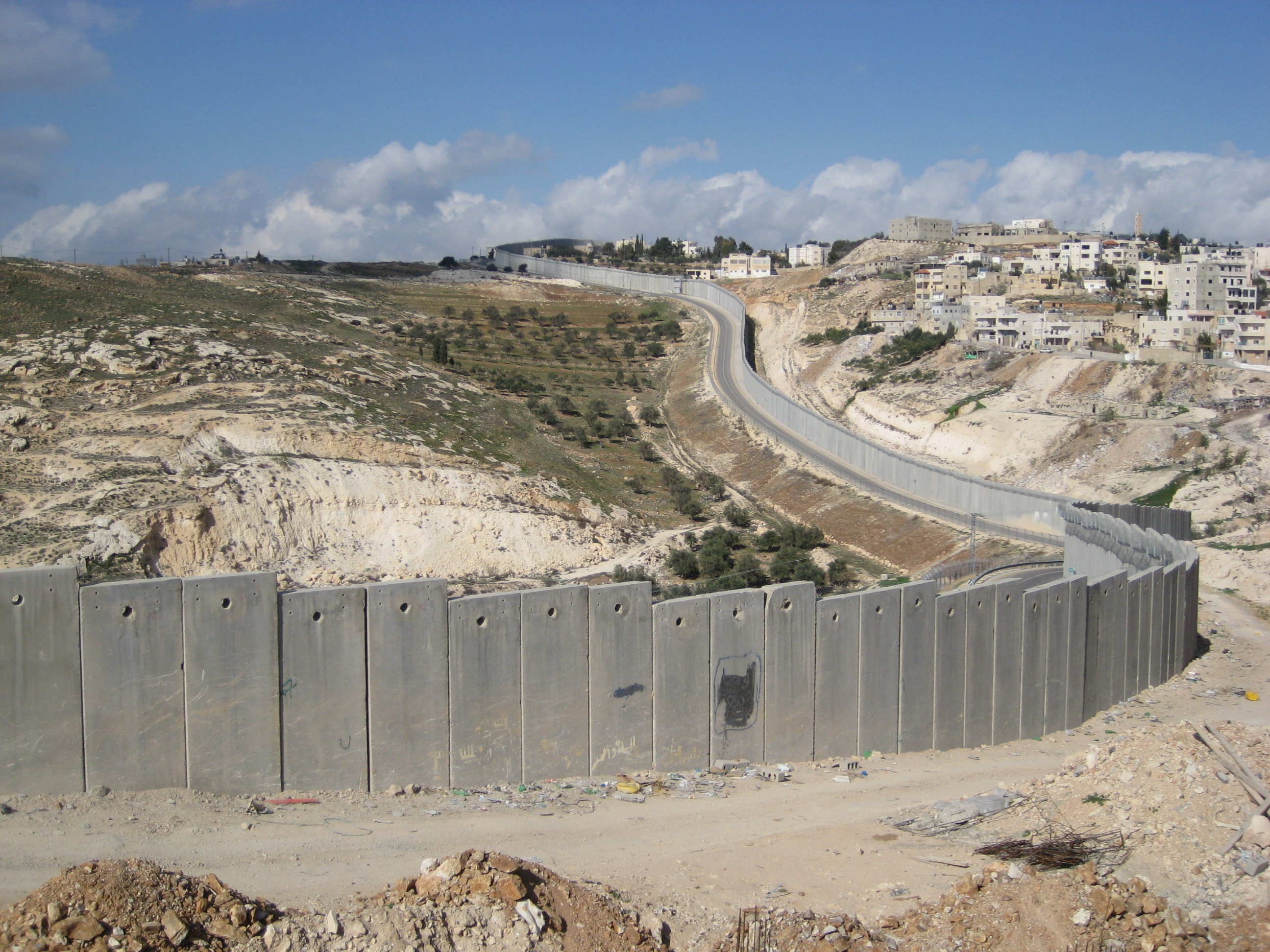
Israel’s Separation Wall cuts through occupied East Jerusalem, dividing neighbourhoods, villages, families, and streets:
The wall epitomises all the tactics of domination. It more than doubles the area of East Jerusalem, creating a clover shape to include the new settlements and their development zones: Bet Horon, Givat Zeev, Givon Hadasha and the future Nabi Samuel park; Har Gilo, Betar Ilit and the Etzion Bloc; Maale Adumim.

OCHA describes the Wall’s deliberate function of inclusion/exclusion:
The route runs deep into the West Bank to encircle the large settlements of Giv’at Zeev (pop. 11,000) and Ma’ale Adummim (pop. 28,000). These settlements currently lie outside the municipal boundary but will be physically connected to Jerusalem by the Barrier. By contrast, densely populated Palestinian areas – Shu’fat Camp, Kafr ‘Aqab, and Samiramees with a total population of over 30,000 – which are currently inside the municipal boundary, are separated from East Jerusalem by the Barrier.
The Wall has created an enclave in Bir Nabala, where 15,000 Palestinians are surrounded. There are now some 50,000 Palestinians with Jerusalem residency who find themselves on the wrong side of the Wall.

Palestinians: immigrants in their own city
The Palestinians of East Jerusalem have ‘permanent residency’ status from the Israeli authorities. They are not citizens. In fact, as Attorney Yotam Ben-Hillel put it, Palestinians of East Jerusalem “are treated as if they were immigrants to Israel, despite the fact that it is Israel that came to them in 1967”.
The next time someone tells you that Israel is the ‘only democracy in the Middle East’, ask them why there are over 100,000 children in Jerusalem who were born without citizenship.
A Palestinian ‘resident’ does not need a permit to live and work in Israel, and is also entitled to health insurance and other social rights. However, ‘residents’ do not have the right to vote in national elections, can not automatically pass this status on to their children, and, are liable to having their ‘permanent residency’ revoked – which can happen without appeal or even notification.
In 2008, Israel stripped over 4,500 Palestinians in East Jerusalem of their residency status, which is a third of the total revocations since 1967. A leaked EU Heads of Mission report in 2005 observed that when it comes to the residency status policy, “Israel’s main motivation is almost certainly demographic”.
Restricting home construction
A fundamental part of Israel’s strategy in East Jerusalem is to restrict the ability for Palestinians to build or expand their houses, which restricts the growth of the community and also makes for conditions in which normal life becomes increasingly untenable.
The Jerusalem municipality’s discriminatory approach to housing means that as many as 40% of houses in East Jerusalem are ‘illegal’, because they were built without having received the proper building permit.
Permits, like in ‘Area C’ of the West Bank, are routinely denied – an EU report last year noted that Silwan had received only 20 building permits since 1967. The process of applying is also highly – often prohibitively – costly: over $25,000 for a 200 sq metre building. In 2009, over 900 demolition orders for Palestinian houses were issued by the Jerusalem municipality, with dozens carried out.
The Israeli newspaper Yediot Yerushaliyim reported in April of last year that the Jerusalem municipality “intends to spend 1.2 million shekels on aerial photographing to track building offenders, in the eastern part of the city in particular”. Earlier this month, Ha’aretz referred to the existence of a NIS 2 million budget “for demolishing and sealing off illegal structures”.
While encouraging and facilitating intensified colonisation of East Jerusalem, Mayor Nir Barkat sometimes feels compelled to make positive noises about providing solutions to the ‘Arab housing shortage’. Yet even when Barkat announced plans for new houses, over two-thirds of the units will take 20 years to complete – by which time, there will be a 74% shortfall in Palestinian housing needs.

The death of Palestinian East Jerusalem and Israeli ‘democracy’
It is not difficult to understand the rationale behind the outworking of the permit system and the demolitions, or to see the vision at work behind all the various policies covered briefly here. Teddy Kollek, mayor of Jerusalem from 1965 to 1993, quotes government officials in his 1994 book as saying that, “[It is necessary] to make life difficult for the Arabs, not to allow them to build…” An engineer and chief planner for the municipality once confirmed that the “only way to manage” the ratio between the Palestinian and Jewish population is “[through manipulation] of housing potential]”.
Amir Cheshin served as senior advisor on ‘Arab Affairs’ for ten years under Kollek and then Ehud Olmert. The book he went on to co-author does not shy away from the reality of Israel’s policies in East Jerusalem:
Kollek spearheaded the effort by Israel to settle east Jerusalem with Jewish families. In 1970 Kollek coauthored the proposal for development in east Jerusalem that became the basis for Israeli policy for the next decade. Indeed, the 1970 Kollek plan contains the principles upon which Israeli housing policy in east Jerusalem is based to this day – expropriation of Arab-owned land, development of large Jewish neighbourhoods in east Jerusalem, and limitations on development in Arab neighbourhoods.
This month, Jerusalem mayor Nir Barkat described the Palestinians in East Jerusalem as a “strategic threat”, at a meeting of a Knesset lobby group. Barkat worried about the percentages, and the difficulty of keeping the Palestinians at 30% of Jerusalem’s population, the apparent goal. As ex-deputy mayor Benvenisti says, “It’s pure racism. We live in the only city in the world where an ethnic population ratio serves as a philosophy”.
In the words of the director of Israel’s Macro Centre for Political Economics, in order “to try to guarantee a Jewish majority and generate Jewish hegemony in Jerusalem”, Israel “has annexed huge parts of Jerusalem, enlarged the boundaries of the municipality, taken lots of land in the eastern part of the city and built more than 50,000 housing units on this land exclusively for Jews”.
This overview of Israel’s deliberate colonisation of East Jerusalem in defiance of international law only begins to scratch the surface. In the international ‘peace process’ and associated media reports, Jerusalem is typically presented as a ‘final status’ issue in the negotiations to establish a Palestinian state. Through policies going back 40 years, Israel’s leaders from across the political spectrum have made it clear that as far as they are concerned, Jerusalem’s ‘status’ is already final.
The current consensus in the international community is that East Jerusalem, occupied by Israel since 1967, is the capital of a future Palestinian state. Israel’s unilateral annexation of territory to create expanded municipal boundaries for a ‘reunited’ Jerusalem was never recognised.
Over the last forty-three years, Israel has created so-called ‘facts on the ground’ in the Occupied Palestinian Territories (OPT), in defiance of international law. Since the Madrid/Oslo peace process, successive Israeli governments have continued to colonise Palestinian land at the same time as conducting negotiations.
The extent and scale of Israel’s illegal settlement project across the West Bank, as well as the road network, the Separation Wall, and other ways in which Israel maintains its rule over the OPT, has led some to believe that the creation of an independent, sovereign Palestinian state is impossible.
Perhaps one of the clearest indicators that there is no Palestinian state-in-waiting under Israel’s regime of control is East Jerusalem.
Israel has three, inter-related strategic goals for East Jerusalem:
- To make the claim that Jerusalem is the ‘eternal, undivided Jewish capital’ a physical reality.
- Increase the Jewish presence/decrease the Palestinian presence (‘the demographic battle’).
- Cut off East Jerusalem from the West Bank.
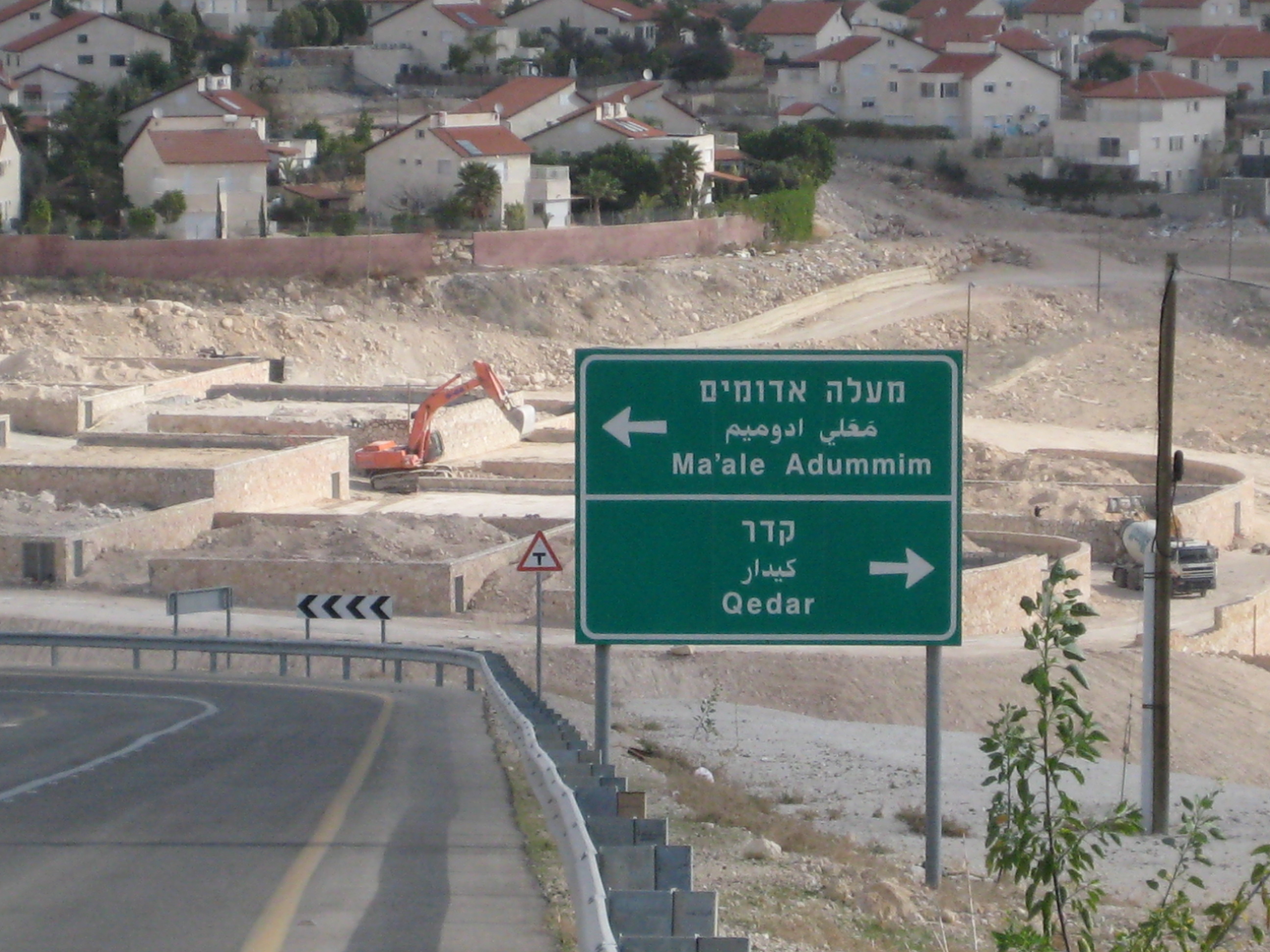
Mapping the land and creating colonies
Since 1967, Israel has created a number of settlements in the unilaterally expanded city boundaries, with a current population of over 180,000. This represents an expansion of 65% since 1987, while the land taken up by the East Jerusalem colonies went up by 143% in the same time frame (OCHA, opens as PDF).

The purpose of the settlements, both those close to the Old City, as well as the ‘outer ring’ (or Jerusalem ‘envelope’) has been to make the annexation of East Jerusalem a fait accompli. As ex-deputy mayor of Jerusalem, Meron Benvenisti commented, the aim of the expropriation of land around Jerusalem just three years into the post-’67 occupation was “to encircle the city with huge dormitory suburbs ‘that would obviate any possibility of the redivision of Jerusalem’”.
Israel’s annexation of land around Jerusalem almost tripled (PDF) the land under the city’s municipal authority. A third of the annexed land was expropriated for settlements, and over forty years, more than 50,000 housing units were built for the Jewish population on this land; none, of course, for Palestinians.
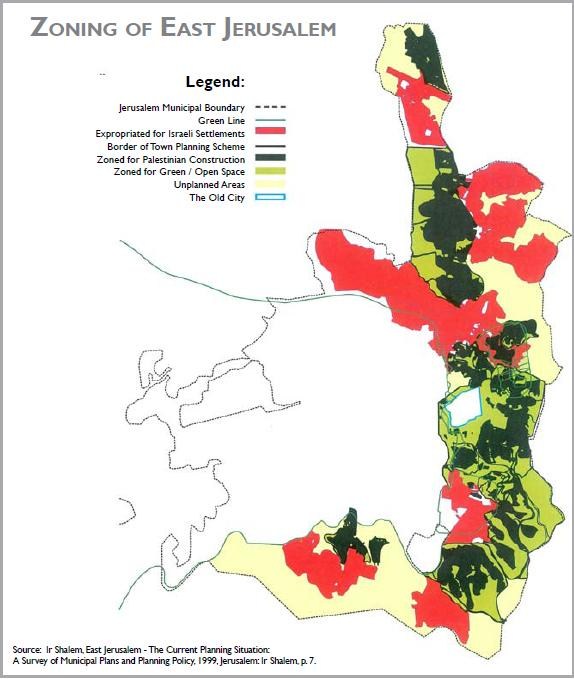
From 2000 to 2009, Israel confiscated PDF) over 40,000 dunams in Jerusalem; just under two-thirds of that total was taken in the last five years (’05-’09). In April last year, the UN OCHA reported (PDF) that only 13% of the Israeli-annexed area of East Jerusalem is ‘zoned’ for Palestinian construction (if permission is obtained).
‘Zoning’ land in East Jerusalem for particular purposes is an important way that Israel limits the natural growth of the Palestinian population. Some areas are declared ‘Green’, meaning no building is permitted there. In Jabal Mukaber, for example, 15,000 Palestinian residents are kept to 20% of the neighbourhood’s land, with the rest marked ‘Green’. However, there are a number of settlements that were built on land previously zoned as ‘Green’.
Targeting Palestinian neighbourhoods
Another strategy that has recently come under the spotlight is the targeting of Palestinian communities in East Jerusalem by extremist religious settler movements. In Sheikh Jarrah, Palestinians are being evicted from their homes in order for religious Jews to move in, a phenomenon described by ex-Tourism Minister – and supporter of the settlers – Benny Elon as “a microcosm of the entire story of Jerusalem”.
(Elon has highlighted Jewish settlement in Sheikh Jarrah as part of a plan “to create a Jewish continuum surrounding the Old City”, with other methods including “declaring open areas to be national parks and placing state property back-to-back with lands under Jewish ownership”.)
The irony about the Sheikh Jarrah evictions is that the settlers are making their case in the courts based on a claim of pre-1948 ownership. Palestinians dispossessed in the Nakba would not be hopeful of regaining their property on the same basis – whether in West Jerusalem or elsewhere.
Is not it absurd that the very same Palestinian whose property was confiscated in 1948 finds that his new home is confiscated on the grounds that it was owned previously to 1948 by Jews? What is it precisely that distinguishes the claim of the Jew from that of the Palestinian?
Meanwhile, archaeological excavations are delegated by Israeli authorities to ideologically-driven right-wing Jewish groups. Silwan is home to the ‘City of David’ project, a tourism-oriented initiative of the settler group Elad. Dozens of Palestinian homes in Silwan are threatened with demolition, while Jerusalem mayor Nir Barkat hopes to develop the area “in terms of historical and religious tourism”.
In May 2009, Ha’aretz revealed that the Israeli Prime Minister’s office and Jerusalem municipality were working with settler groups to “surround the Old City of Jerusalem with nine national parks, pathways and sites”. The Jerusalem Development Authority said the aim was “to strengthen Jerusalem as the capital of the State of Israel”.
The Israel Lands Administration works “together with the [settlement-promoting] Ateret Cohanim association”, while the new “Samaria and Judea District Police” headquarters in the strategic E1 area received funding from both the state and right-wing Jewish groups. It is little wonder that EU consuls in East Jerusalem felt moved to accuse “the Israeli government and the Jerusalem municipality” of assisting right-wing groups in “their efforts to implement this ‘strategic vision’ [of altering the city’s demographic balance and severing East Jerusalem from the West Bank].
The road network
Planning transportation links, and particularly road networks, is a vital part of shaping the nature of how a city develops. The Jerusalem municipality understands this, and thus the roads that go through and around occupied East Jerusalem are another part of Israel’s strategy.
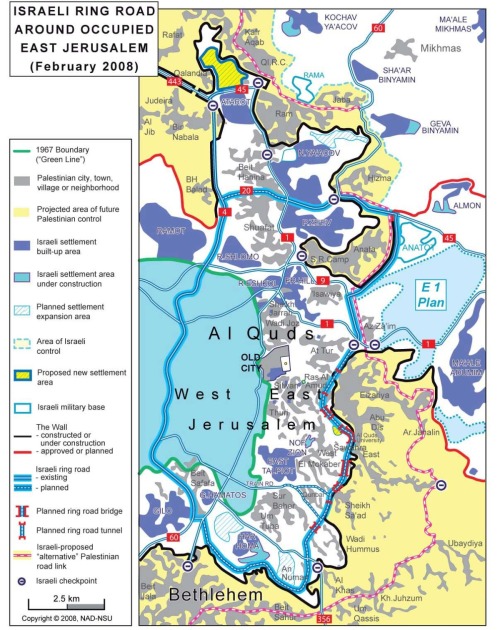
One particularly key project is the Eastern Ring Road, the idea of which is to ‘join the dots’ between Israeli colonies in East Jerusalem, and West Jerusalem. A proposed 11km section of the route goes through numerous Palestinian villages and neighbourhoods of Jerusalem, meaning the confiscation of over 1,000 dunams of land. According to a report in the Jerusalem Post in 2006, the idea of the ring road goes back some years, “and was first sketched onto maps by Ariel Sharon during his tenure as a Likud minister and planner of construction efforts designed to erase Israel’s Green Line boundary with the West Bank”.
Palestinians, meanwhile, are being built ‘alternative’ roads, in order to link up different enclaves. When serving as the UN’s Special Rapporteur for Human Rights in the OPT, South African legal professor John Dugard described what he called “Israel’s broader plan to replace territorial contiguity with ‘transportational contiguity’ by artificially connecting Palestinian population centres through an elaborate network of alternate roads and tunnels and creating segregated road networks, one for Palestinians and another for Israeli settlers, in the West Bank”.
It is also important to mention the Jerusalem Light Rail, a project that has suffered setbacks on account of the international BDS movement. Once again, while the public, official purpose of the rail line is “relieving traffic congestion and renewal of the city centre”, the map of the route confirms that is another way of the Jerusalem municipality consolidating the colonisation of the eastern half of the city.
The dividing Wall
Israel’s Separation Wall cuts through occupied East Jerusalem, dividing neighbourhoods, villages, families, and streets:
The wall epitomises all the tactics of domination. It more than doubles the area of East Jerusalem, creating a clover shape to include the new settlements and their development zones: Bet Horon, Givat Zeev, Givon Hadasha and the future Nabi Samuel park; Har Gilo, Betar Ilit and the Etzion Bloc; Maale Adumim.
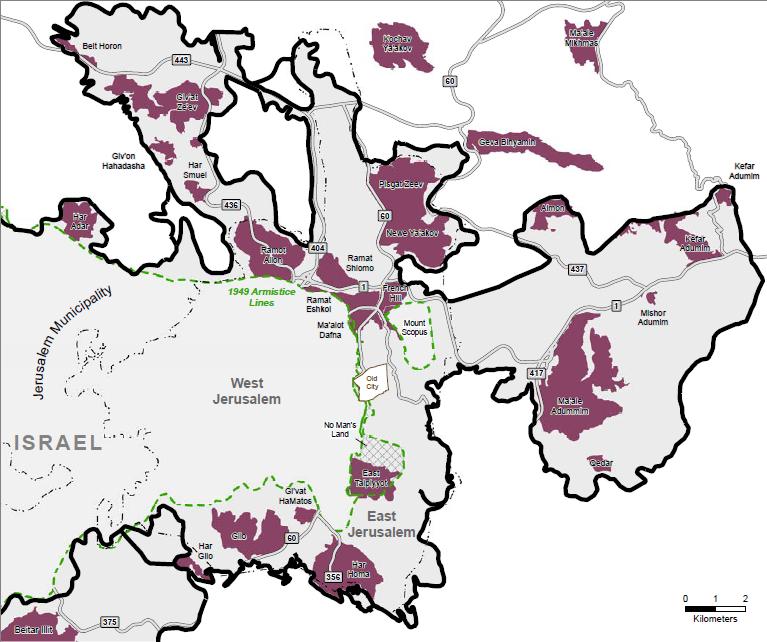
OCHA describes the Wall’s deliberate function of inclusion/exclusion:
The route runs deep into the West Bank to encircle the large settlements of Giv’at Zeev (pop. 11,000) and Ma’ale Adummim (pop. 28,000). These settlements currently lie outside the municipal boundary but will be physically connected to Jerusalem by the Barrier. By contrast, densely populated Palestinian areas – Shu’fat Camp, Kafr ‘Aqab, and Samiramees with a total population of over 30,000 – which are currently inside the municipal boundary, are separated from East Jerusalem by the Barrier.
The Wall has created an enclave in Bir Nabala, where 15,000 Palestinians are surrounded. There are now some 50,000 Palestinians with Jerusalem residency who find themselves on the wrong side of the Wall.
Palestinians: immigrants in their own city
The Palestinians of East Jerusalem have ‘permanent residency’ status from the Israeli authorities. They are not citizens. In fact, as Attorney Yotam Ben-Hillel put it, Palestinians of East Jerusalem “are treated as if they were immigrants to Israel, despite the fact that it is Israel that came to them in 1967”.
The next time someone tells you that Israel is the ‘only democracy in the Middle East’, ask them why there are over 100,000 children in Jerusalem who were born without citizenship.
A Palestinian ‘resident’ does not need a permit to live and work in Israel, and is also entitled to health insurance and other social rights. However, ‘residents’ do not have the right to vote in national elections, can not automatically pass this status on to their children, and, are liable to having their ‘permanent residency’ revoked – which can happen without appeal or even notification.
In 2008, Israel stripped over 4,500 Palestinians in East Jerusalem of their residency status, which is a third of the total revocations since 1967. A leaked EU Heads of Mission report in 2005 observed that when it comes to the residency status policy, “Israel’s main motivation is almost certainly demographic”.
Restricting home construction
A fundamental part of Israel’s strategy in East Jerusalem is to restrict the ability for Palestinians to build or expand their houses, which restricts the growth of the community and also makes for conditions in which normal life becomes increasingly untenable.
The Jerusalem municipality’s discriminatory approach to housing means that as many as 40% of houses in East Jerusalem are ‘illegal’, because they were built without having received the proper building permit.
Permits, like in ‘Area C’ of the West Bank, are routinely denied – an EU report last year noted that Silwan had received only 20 building permits since 1967. The process of applying is also highly – often prohibitively – costly: over $25,000 for a 200 sq metre building. In 2009, over 900 demolition orders for Palestinian houses were issued by the Jerusalem municipality, with dozens carried out.
The Israeli newspaper Yediot Yerushaliyim reported in April of last year that the Jerusalem municipality “intends to spend 1.2 million shekels on aerial photographing to track building offenders, in the eastern part of the city in particular”. Earlier this month, Ha’aretz referred to the existence of a NIS 2 million budget “for demolishing and sealing off illegal structures”.
While encouraging and facilitating intensified colonisation of East Jerusalem, Mayor Nir Barkat sometimes feels compelled to make positive noises about providing solutions to the ‘Arab housing shortage’. Yet even when Barkat announced plans for new houses, over two-thirds of the units will take 20 years to complete – by which time, there will be a 74% shortfall in Palestinian housing needs.

The death of Palestinian East Jerusalem and Israeli ‘democracy’
It is not difficult to understand the rationale behind the outworking of the permit system and the demolitions, or to see the vision at work behind all the various policies covered briefly here. Teddy Kollek, mayor of Jerusalem from 1965 to 1993, quotes government officials in his 1994 book as saying that, “[It is necessary] to make life difficult for the Arabs, not to allow them to build…” An engineer and chief planner for the municipality once confirmed that the “only way to manage” the ratio between the Palestinian and Jewish population is “[through manipulation] of housing potential]”.
Amir Cheshin served as senior advisor on ‘Arab Affairs’ for ten years under Kollek and then Ehud Olmert. The book he went on to co-author does not shy away from the reality of Israel’s policies in East Jerusalem:
Kollek spearheaded the effort by Israel to settle east Jerusalem with Jewish families. In 1970 Kollek coauthored the proposal for development in east Jerusalem that became the basis for Israeli policy for the next decade. Indeed, the 1970 Kollek plan contains the principles upon which Israeli housing policy in east Jerusalem is based to this day – expropriation of Arab-owned land, development of large Jewish neighbourhoods in east Jerusalem, and limitations on development in Arab neighbourhoods.
This month, Jerusalem mayor Nir Barkat described the Palestinians in East Jerusalem as a “strategic threat”, at a meeting of a Knesset lobby group. Barkat worried about the percentages, and the difficulty of keeping the Palestinians at 30% of Jerusalem’s population, the apparent goal. As ex-deputy mayor Benvenisti says, “It’s pure racism. We live in the only city in the world where an ethnic population ratio serves as a philosophy”.
In the words of the director of Israel’s Macro Centre for Political Economics, in order “to try to guarantee a Jewish majority and generate Jewish hegemony in Jerusalem”, Israel “has annexed huge parts of Jerusalem, enlarged the boundaries of the municipality, taken lots of land in the eastern part of the city and built more than 50,000 housing units on this land exclusively for Jews”.
This overview of Israel’s deliberate colonisation of East Jerusalem in defiance of international law only begins to scratch the surface. In the international ‘peace process’ and associated media reports, Jerusalem is typically presented as a ‘final status’ issue in the negotiations to establish a Palestinian state. Through policies going back 40 years, Israel’s leaders from across the political spectrum have made it clear that as far as they are concerned, Jerusalem’s ‘status’ is already final.
Auschwitz survivor: ‘Israel acts like Nazis’
Exclusive: Graeme Murray and Chris Watt

One of the last remaining Auschwitz survivors has launched a blistering attack on Israel over its occupation of Palestine as he began a lecture tour of Scotland.
Dr Hajo Meyer, 86, who survived 10 months in the Nazi death camp, spoke out as his 10-day tour of the UK and Ireland – taking in three Scottish venues – got under way. His comments sparked a furious reaction from hardline Jewish lobby groups, with Dr Meyer branded an “anti-Semite” and accused of abusing his position as a Holocaust survivor.
Dr Meyer also attended hearings at Edinburgh Sheriff Court on Thursday, where five pro-Palestine campaigners are accused of racially aggravated conduct after disrupting a concert by the Jerusalem Quartet at the city’s Queen’s Hall.
Speaking as his tour got under way, Dr Meyer said there were parallels between the treatment of Jews by Germans in the Second World War and the current treatment of Palestinians by Israelis.
He said: “The Israelis tried to dehumanise the Palestinians, just like the Nazis tried to dehumanise me. Nobody should dehumanise any other and those who try to dehumanise another are not human.
“It may be that Israel is not the most cruel country in the world … but one thing I know for sure is that Israel is the world champion in pretending to be civilised and cultured.”
Dr Meyer was born in 1924 in Bielefeld, Germany. He was not allowed to attend school there after November 1938. He then fled to the Netherlands, alone. In 1944, after a year in the underground, he was caught by the Gestapo and survived 10 months at Auschwitz concentration camp in Poland.
He now lives in the Netherlands, and is the author of three books on Judaism, the Holocaust and Zionism.
Dr Meyer also insisted the definition of “anti-Semitic” had now changed, saying: “Formerly an anti-Semite was somebody who hated Jews because they were Jews and had a Jewish soul. But nowadays an anti-Semite is somebody who is hated by Jews.”
A spokesman for the International Jewish Anti-Zionist Network, of which Dr Meyer is a member, said criticising Israel was “not the same” as criticising Jews.
Mick Napier, Scottish Palestine Solidarity Campaign chairman and one of the five demonstrators facing charges when the court case continues in March, said: “Palestinians are happy to have him as an ally in their cause.
“Hajo knows that Israel has a long history of abusing the tragic history of the Holocaust in order to suppress legitimate criticism of its own crimes.
“Especially since Gaza, people are no longer taken in by their claim that anyone that criticises Israel is anti-Semitic.”
Dr Meyer’s claims met with a furious reaction from pro-Israel groups, who branded him “a disgrace”.
Jonathan Hoffman, co-vice-chairman of the Zionist Federation, said: “I shall be telling him he is abusing his status as a survivor, and I shall be telling him that if Israel had been created 10 years earlier, millions of lives might have been saved.
“Whether he is a survivor or not, to use Nazi comparisons in relation to Israel’s policies is anti-Semitic, unquestionably.”
The tour was cynically timed, Mr Hoffman added, to coincide with Holocaust Memorial Day on January 27.
Dr Ezra Golombok, Scottish spokesman for the Israel Information Office, accused the anti-zionist lobby of “exploiting” Dr Meyer, who he described as someone “who’s got into a situation he doesn’t understand”.
“This is a propaganda exercise by Mick Napier and his friends, and nothing more. It’s preposterous to compare Israel with Nazi tactics.”
The lecture series, entitled Never Again – For Anyone, continues until January 30.

Dr Hajo Meyer, 86, who survived 10 months in the Nazi death camp, spoke out as his 10-day tour of the UK and Ireland – taking in three Scottish venues – got under way. His comments sparked a furious reaction from hardline Jewish lobby groups, with Dr Meyer branded an “anti-Semite” and accused of abusing his position as a Holocaust survivor.
Dr Meyer also attended hearings at Edinburgh Sheriff Court on Thursday, where five pro-Palestine campaigners are accused of racially aggravated conduct after disrupting a concert by the Jerusalem Quartet at the city’s Queen’s Hall.
Speaking as his tour got under way, Dr Meyer said there were parallels between the treatment of Jews by Germans in the Second World War and the current treatment of Palestinians by Israelis.
He said: “The Israelis tried to dehumanise the Palestinians, just like the Nazis tried to dehumanise me. Nobody should dehumanise any other and those who try to dehumanise another are not human.
“It may be that Israel is not the most cruel country in the world … but one thing I know for sure is that Israel is the world champion in pretending to be civilised and cultured.”
Dr Meyer was born in 1924 in Bielefeld, Germany. He was not allowed to attend school there after November 1938. He then fled to the Netherlands, alone. In 1944, after a year in the underground, he was caught by the Gestapo and survived 10 months at Auschwitz concentration camp in Poland.
He now lives in the Netherlands, and is the author of three books on Judaism, the Holocaust and Zionism.
Dr Meyer also insisted the definition of “anti-Semitic” had now changed, saying: “Formerly an anti-Semite was somebody who hated Jews because they were Jews and had a Jewish soul. But nowadays an anti-Semite is somebody who is hated by Jews.”
A spokesman for the International Jewish Anti-Zionist Network, of which Dr Meyer is a member, said criticising Israel was “not the same” as criticising Jews.
Mick Napier, Scottish Palestine Solidarity Campaign chairman and one of the five demonstrators facing charges when the court case continues in March, said: “Palestinians are happy to have him as an ally in their cause.
“Hajo knows that Israel has a long history of abusing the tragic history of the Holocaust in order to suppress legitimate criticism of its own crimes.
“Especially since Gaza, people are no longer taken in by their claim that anyone that criticises Israel is anti-Semitic.”
Dr Meyer’s claims met with a furious reaction from pro-Israel groups, who branded him “a disgrace”.
Jonathan Hoffman, co-vice-chairman of the Zionist Federation, said: “I shall be telling him he is abusing his status as a survivor, and I shall be telling him that if Israel had been created 10 years earlier, millions of lives might have been saved.
“Whether he is a survivor or not, to use Nazi comparisons in relation to Israel’s policies is anti-Semitic, unquestionably.”
The tour was cynically timed, Mr Hoffman added, to coincide with Holocaust Memorial Day on January 27.
Dr Ezra Golombok, Scottish spokesman for the Israel Information Office, accused the anti-zionist lobby of “exploiting” Dr Meyer, who he described as someone “who’s got into a situation he doesn’t understand”.
“This is a propaganda exercise by Mick Napier and his friends, and nothing more. It’s preposterous to compare Israel with Nazi tactics.”
The lecture series, entitled Never Again – For Anyone, continues until January 30.
Holocaust Survivor Protests Israeli Massacre in Gaza - 2009
Elderly Holocaust Survivor protests Israel's response to Hamas rocket attacks.
http://www.youtube.com/watch?v=X1NWucpa9Nc
http://www.youtube.com/watch?v=X1NWucpa9Nc
Israeli forces detain 5 teens near Nablus

Ghassan Daghlas, a Palestinian Authority official responsible for monitoring settlement activities in the northern West Bank, told Ma’an that several Israeli military vehicles stormed the village at midnight, and seized five young men after ransacking their homes.
He identified the detainees as 18-year-old Muhannad Seif, 17-year-old Yafi’ Suheil, 17-year-old Ashraf Hajja, 15-year-old Walid Daghlas, and 16-year-old Fadi Abu Omar.
Background: I stayed in this village for a week keeping night vigils. These boys were our friends. We played table tennis with them almost every night. Muhannad will spend at least 3 years in prison. The other 4 boys, since they are under age, will serve a lesser sentence of 1 to 1 1/2 years. What are they charged with you might ask...stone throwing & they will not be aloud to see their families. It is very frustrating. Where is the justice!?
Dr. Norman G. Finkelstein - University of Waterloo
Dr. Norman Finkelstein debunks a holocaust card thrown by a Jewish girl, having crocodile tears in her eyes, with a holocaust card of his own but of different nature.
http://www.youtube.com/watch?v=5B7ijMjc2Js
http://www.youtube.com/watch?v=5B7ijMjc2Js
Palestinians prepare to enter record books with longest caricature

Muhammad An-Nimnim, known as Abu Noon, the director of Artists for Freedom in Palestine and a Palestinian cartoonist, told Ma’an that the participants are in preparation and making the necessary arrangements to enter the record books with the longest caricature in 2010.
Abu Noon said he hopes that the picture will be drawn on the separation wall in Bethlehem in the West Bank, to boost tourism to the city. International artists will also participate in the caricature's creation, in support of peace, he said.
Coordination with a consulate is underway to complete the necessary procedures to allow the artists to begin drawing on the wall in Bethlehem, he added.
The caricature, he said, will express peace and the universal language of art. "Everyone talks about peace but no one listens, but today we will express our will, strengthen our steadfastness, and prove to the world that we want peace," said Abu Noon.
Abu Noon said that he has received over 45 applications from artists in the Palestinian territories and around the world, including international artists.
An-Nimnim called on President Mahmoud Abbas and the Palestinian Authority to facilitate the provision of legal and operational procedures to allow the event to take place on the part of the wall that closes off Bethlehem.
Palestinians have previously entered the Guinness Book of World Records for the world's largest plate of Kanafeh (a dessert made with semolina and white cheese) and the longest traditional dress.
Deir Yassin Massacre Documentary
Video about the Deir Yassin Massacre committed by the Zionist terrorists in 1948.
http://www.youtube.com/watch?v=prLPvqttW9c&feature=related
http://www.youtube.com/watch?v=prLPvqttW9c&feature=related
January 26, 2010
Israel uses depleted uranium against Palestinians in Gaza
 London, January 26, 2010 (Pal Telegraph) - A London-based Palestinian activist announced that the buildings damaged in the Gaza Strip after the Israeli onslaught last year all showed signs of contamination with depleted uranium.
"The ruined buildings and debris left after the Israeli attack on Gaza are contaminated with depleted uranium and similar types of weapons," said Sameh Habeeb, spokesperson for the Palestinian Return Center in London.
The activist quoted international nuclear experts as saying that the contaminated materials will be severely destructive and hazardous to Palestinian residents in the long run.
Habeeb criticized the United Nations for its inefficiency in providing the Palestinian people with proper services, saying that the international body has avoided proper measures to clean the contaminated areas.
The activist called on the UN to launch a probe into the type of weapons used by the Israeli troops during the 22-day war on Gaza last year.
Israel began waging war on the Gaza Strip on Dec. 27, 2008, and managed to kill a total 95 resistance fighters. Its major targets, however, were residential areas, mosques and medical centers.
The full-scale offensive led to the death of at least 1,400 Palestinian civilians, many of them women and children. Officials from various international bodies have confirmed that Tel Aviv resorted to unconventional weapons and terror tactics. Israel's casualties in the conflict were estimated at 13, including 10 military personnel.
The Israeli attack on Gaza is estimated by the Palestinian Central Bureau of Statistics to have caused nearly $2 billion worth of damage.
The (Sheikh Jarrah) revolution won't be televised... it'll be YouTubed
By Abe Selig, The Jerusalem Post

Social media sites like Facebook, YouTube and Twitter, along with a slew of blogs, are playing an increasing role in the growing participation of young Israelis in protest rallies in the east Jerusalem neighborhood of Sheikh Jarrah, activists and journalists familiar with the situation there told The Jerusalem Post on Monday.
Activists and journalists both described a situation in which protesters were relying on the Internet to try and affect change on the ground and raise awareness of the arrests made during demonstrations in the neighborhood.
“It’s all Facebook, e-mails and Twitter,” said Didi Remez, a human rights activist, who has become noticeably involved in the Sheikh Jarrah protests as of late. Remez was arrested during a protest there last Friday.
Remez also said that distant audiences, like American Jews, who might be deprived of Sheikh Jarrah coverage due to the mainstream media’s lack of interest, were instead staying abreast of the situation via social networking sites.
“The American media is for some reason refusing to cover this,” he said. “Even though it’s becoming a major issue in Israel. And still, despite that, there’s a lot of awareness [of this issue] among Jewish Americans, the reason being that they are increasingly connected through Facebook, Twitter, blogs and so on.”
“They’re getting information on this without The New York Times,” Remez continued. “So, something that hasn’t been covered at all by the [American] mainstream media, is still getting coverage through new media, and I think that’s a statement about the decline of the mainstream media and maybe a larger comment on the shift away from it.”
Others echoed Remez’s comments, but added that another advantage of social media was its ability to counter police statements about Sheikh Jarrah they said the mainstream media often parroted.
“This is an issue that the media hasn’t really been covering, and when they have, they’ve mostly relied on police statements that portrayed the protesters as a handful of extreme leftists or anarchists, which is simply not true,” said Lisa Goldman, a Tel-Aviv based freelance journalist who has used Facebook, Twitter and blogs to follow the Sheikh Jarrah protests.
“What the social media outlets have been able to provide is a direct source of information that isn’t filtered through the mainstream media,” she said, adding that in this vein, the use of new media had been “absolutely crucial.”
Additionally, Goldman added, social media outlets had also served as a tool to awaken the mainstream Left to the goings-on in Sheikh Jarrah, including, but not limited to, the emerging issue of police behavior towards protesters there, which the Jerusalem Magistrate Court has even censured – ruling last week that the arrests of 17 protesters during a rally two weeks ago was illegal.
“The silent Israeli Left is finally waking up,” she said. “And it’s a result of the way some young people are using social media. It’s been very effective in raising awareness among the moderate Left, who are seeing that the police are suppressing free speech.”
Goldman also pointed to the participation in last Friday’s rally of Prof. Moshe Halbertal, who helped draft the IDF code of ethics and who has been active in disputing the United Nation’s Goldstone Report, as an example of figures who would certainly not be considered extreme, but who have joined the Sheikh Jarrah fray.
Hagai El-Ad, the director of the Association for Human Rights in Israel and one of the 17 protesters arrested two weeks ago, added that the use of new media to circumvent the mainstream media, which, he said, was often “reluctant to cover hard issues, or blatantly hostile,” was spreading rapidly.
“However, it’s not just new media [at play in Sheikh Jarrah],” he said. “I think there’s a need to [step back] from the tactics being used there, and zoom in on the core issue, which is the moral outrage of Jerusalemite families being thrown out of their homes and living in tents in the street. That’s the essential injustice here, and I think it’s a fuel of its own.”
Yet El-Ad did concede that the use of new media was a driving force behind the success of the Sheikh Jarrah protest organizers.
“They are a courageous group of young people, who are functioning without any real budget or resources,” he said. “But they are cleverly online, and they’ve been able to translate that into real movement on the ground – it’s not just a Facebook group that people add their names too.”
“Yes, the mobilization happens online,” El-Ad added, “but the end result is the most classic form of civil protest.”
Sheikh Jarrah protest as shown on YouTube - Jan 2010
Activists and journalists both described a situation in which protesters were relying on the Internet to try and affect change on the ground and raise awareness of the arrests made during demonstrations in the neighborhood.
“It’s all Facebook, e-mails and Twitter,” said Didi Remez, a human rights activist, who has become noticeably involved in the Sheikh Jarrah protests as of late. Remez was arrested during a protest there last Friday.
Remez also said that distant audiences, like American Jews, who might be deprived of Sheikh Jarrah coverage due to the mainstream media’s lack of interest, were instead staying abreast of the situation via social networking sites.
“The American media is for some reason refusing to cover this,” he said. “Even though it’s becoming a major issue in Israel. And still, despite that, there’s a lot of awareness [of this issue] among Jewish Americans, the reason being that they are increasingly connected through Facebook, Twitter, blogs and so on.”
“They’re getting information on this without The New York Times,” Remez continued. “So, something that hasn’t been covered at all by the [American] mainstream media, is still getting coverage through new media, and I think that’s a statement about the decline of the mainstream media and maybe a larger comment on the shift away from it.”
Others echoed Remez’s comments, but added that another advantage of social media was its ability to counter police statements about Sheikh Jarrah they said the mainstream media often parroted.
“This is an issue that the media hasn’t really been covering, and when they have, they’ve mostly relied on police statements that portrayed the protesters as a handful of extreme leftists or anarchists, which is simply not true,” said Lisa Goldman, a Tel-Aviv based freelance journalist who has used Facebook, Twitter and blogs to follow the Sheikh Jarrah protests.
“What the social media outlets have been able to provide is a direct source of information that isn’t filtered through the mainstream media,” she said, adding that in this vein, the use of new media had been “absolutely crucial.”
Additionally, Goldman added, social media outlets had also served as a tool to awaken the mainstream Left to the goings-on in Sheikh Jarrah, including, but not limited to, the emerging issue of police behavior towards protesters there, which the Jerusalem Magistrate Court has even censured – ruling last week that the arrests of 17 protesters during a rally two weeks ago was illegal.
“The silent Israeli Left is finally waking up,” she said. “And it’s a result of the way some young people are using social media. It’s been very effective in raising awareness among the moderate Left, who are seeing that the police are suppressing free speech.”
Goldman also pointed to the participation in last Friday’s rally of Prof. Moshe Halbertal, who helped draft the IDF code of ethics and who has been active in disputing the United Nation’s Goldstone Report, as an example of figures who would certainly not be considered extreme, but who have joined the Sheikh Jarrah fray.
Hagai El-Ad, the director of the Association for Human Rights in Israel and one of the 17 protesters arrested two weeks ago, added that the use of new media to circumvent the mainstream media, which, he said, was often “reluctant to cover hard issues, or blatantly hostile,” was spreading rapidly.
“However, it’s not just new media [at play in Sheikh Jarrah],” he said. “I think there’s a need to [step back] from the tactics being used there, and zoom in on the core issue, which is the moral outrage of Jerusalemite families being thrown out of their homes and living in tents in the street. That’s the essential injustice here, and I think it’s a fuel of its own.”
Yet El-Ad did concede that the use of new media was a driving force behind the success of the Sheikh Jarrah protest organizers.
“They are a courageous group of young people, who are functioning without any real budget or resources,” he said. “But they are cleverly online, and they’ve been able to translate that into real movement on the ground – it’s not just a Facebook group that people add their names too.”
“Yes, the mobilization happens online,” El-Ad added, “but the end result is the most classic form of civil protest.”
Subscribe to:
Posts (Atom)